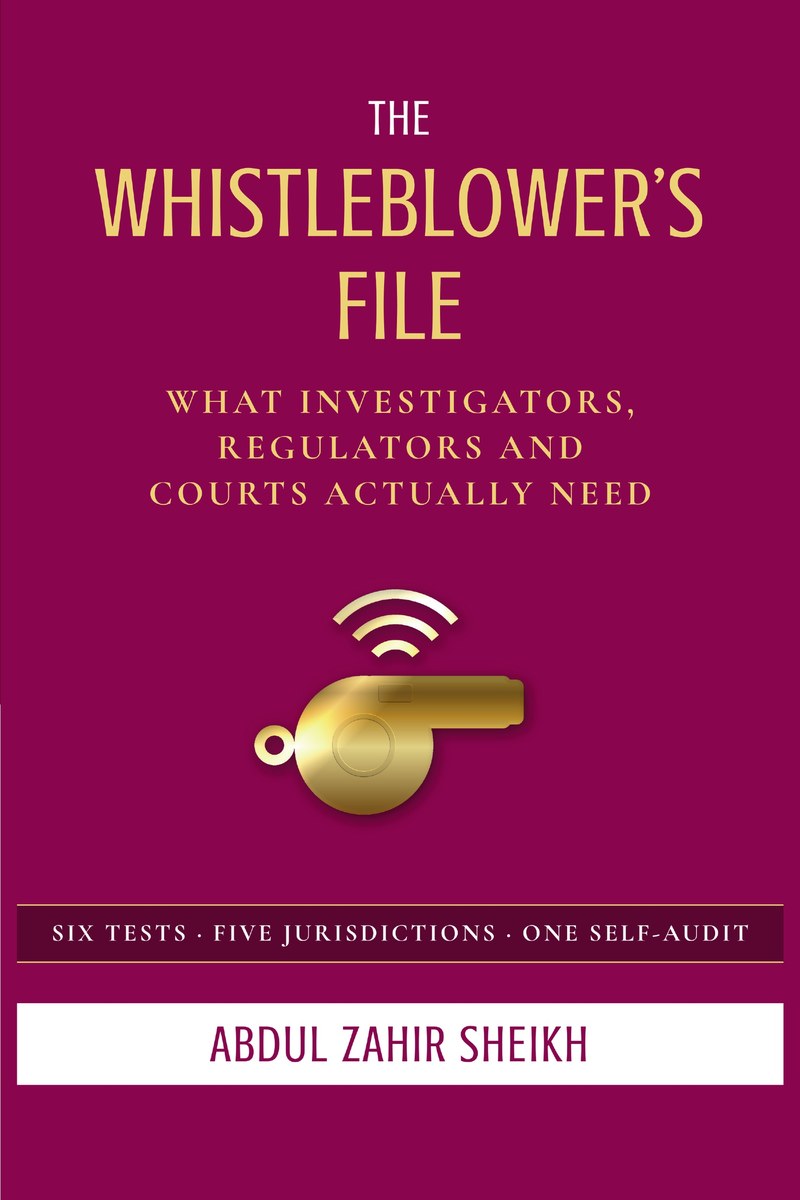
The Whistleblower’s File
Six Tests · Five Jurisdictions · One Self-Audit
What Investigators, Regulators and Courts Actually Need
What separates a report that is acted on from one that is dismissed? Six tests, five jurisdictions, graded case files and a one-page self-audit to run before you speak.
- Paperback
- 978-9914-776-64-5
- eBook
- 978-9914-776-63-8
- Audiobook
- Google Play
The book in ten slides
About three minutes; each slide stays up long enough to read
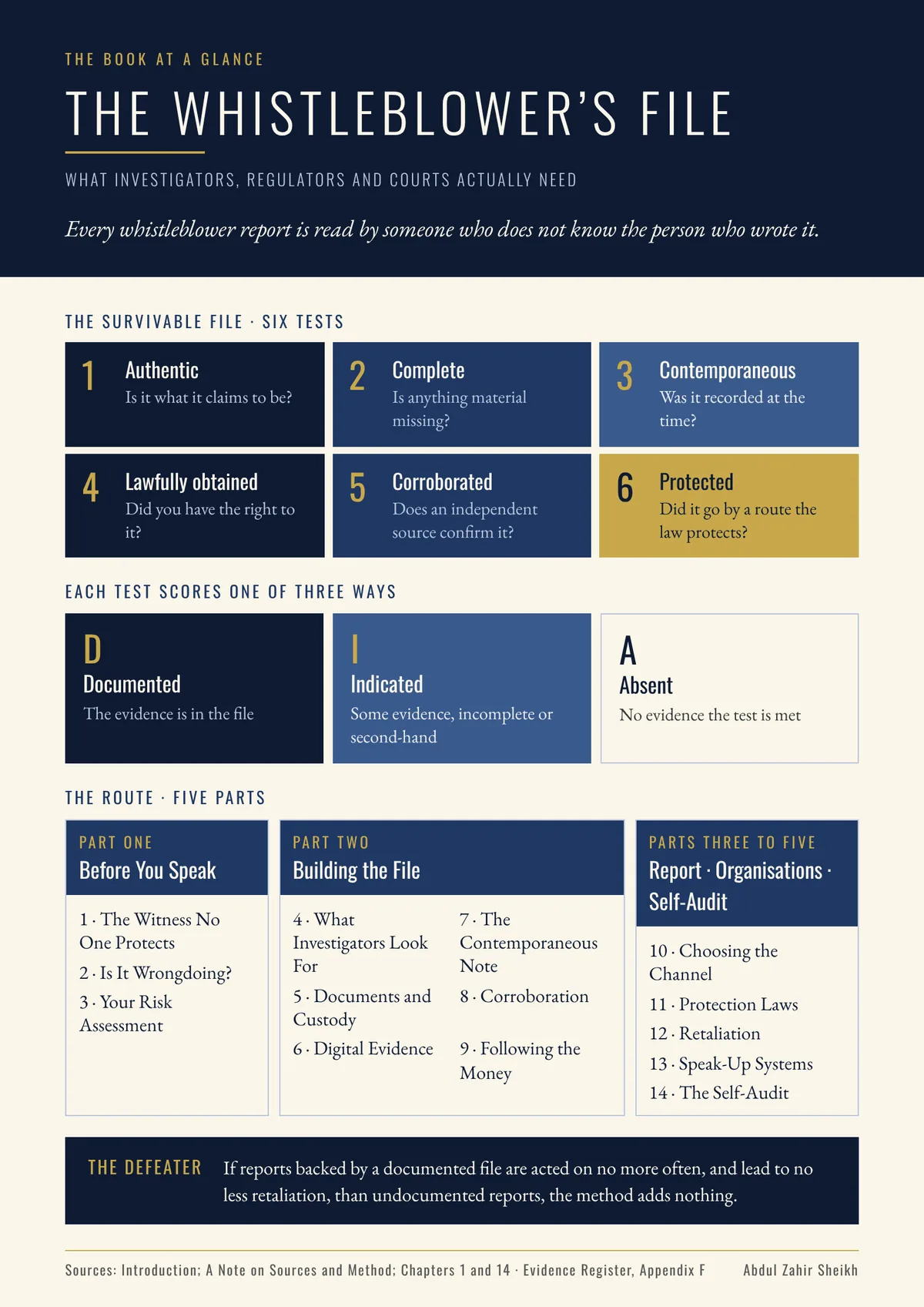
The book at a glance
One page: the structure, the measure and the standard
About the book
Every whistleblower report is read by someone who does not know the person who wrote it. This book shows what the report must carry to survive that reader.
In September 2014 a finance employee at Tesco took a report on supplier income past his superiors to the parent company’s legal department. Within a day the chief executive knew. Within four days the company had told the market. In April 2012 a member of staff at Imperial Bank emailed the Central Bank of Kenya, alleging money laundering and secret accounts abroad. Three years later the bank was in receivership, with at least Sh44.8 billion missing. Both people were courageous. One report carried dates, figures and how the accounting worked. The other carried an allegation.
Claims are cheap. Records are not.
The instrument is the Survivable File: six tests any reader can answer from documents. Authentic, complete, contemporaneous, lawfully obtained, corroborated and protected. The book states its defeat before its case. If reports backed by a documented file are acted on no more often, and lead to no less retaliation, than undocumented reports, the method adds nothing. Chapter 1 runs that test and reports the result.
The chapters then take the tests one at a time: what investigators actually look for, documents and chain of custody, digital evidence without breaking the law, the contemporaneous note, corroboration and following the money. Then the channel: the order in which to use them, protection laws compared in five jurisdictions, and how to recognise, document and answer retaliation. For compliance officers and boards, a speak-up system built to the same six conditions, against ISO 37002.
Every grading is published, so every grading can be checked.
Every case and figure comes from published sources. Each source is graded A to D, the rules were fixed before any case file was graded, and the Evidence Register sets out every grading test by test. Case files come from the United States, the United Kingdom, the European Union, South Africa and Kenya. The book does not tell anyone whether to report, gives no legal advice and accuses no one. It promises only that a good file is harder to dismiss.
Written by Abdul Zahir Sheikh, a Certified Fraud Examiner and Senior Partner at BDO East Africa with four decades of investigative experience, more than a hundred forensic investigations and over thirty receiverships across fourteen countries, it is a companion to The Incentive File and The Board’s Evidence. All three ask for the record before the conclusion.
Before you ask whether you will be believed, ask what your file would need to survive.
More books
 The Quran’s Hidden Architecture
 The Googol Verdict
 The Creator’s Signature on the World He Made
 Knowing the Creator
 The Authentication Test
 The Origination Map
 The Common Source
 The Network of Truth
 The Zakat Theorem
 The Crucifixion File
 The Just Law
 The Absolute Benchmark
 The Just Creator
 One Creator, One Humanity
 The Sound Heart
 The Leadership Evidence Map
 Business Results at the Speed of AI
 The Incentive File
 The Board’s Evidence
 The Ramadan Experiment
 The Settled Account
 Finishing Strong
 Under One Roof
 Blood Ties