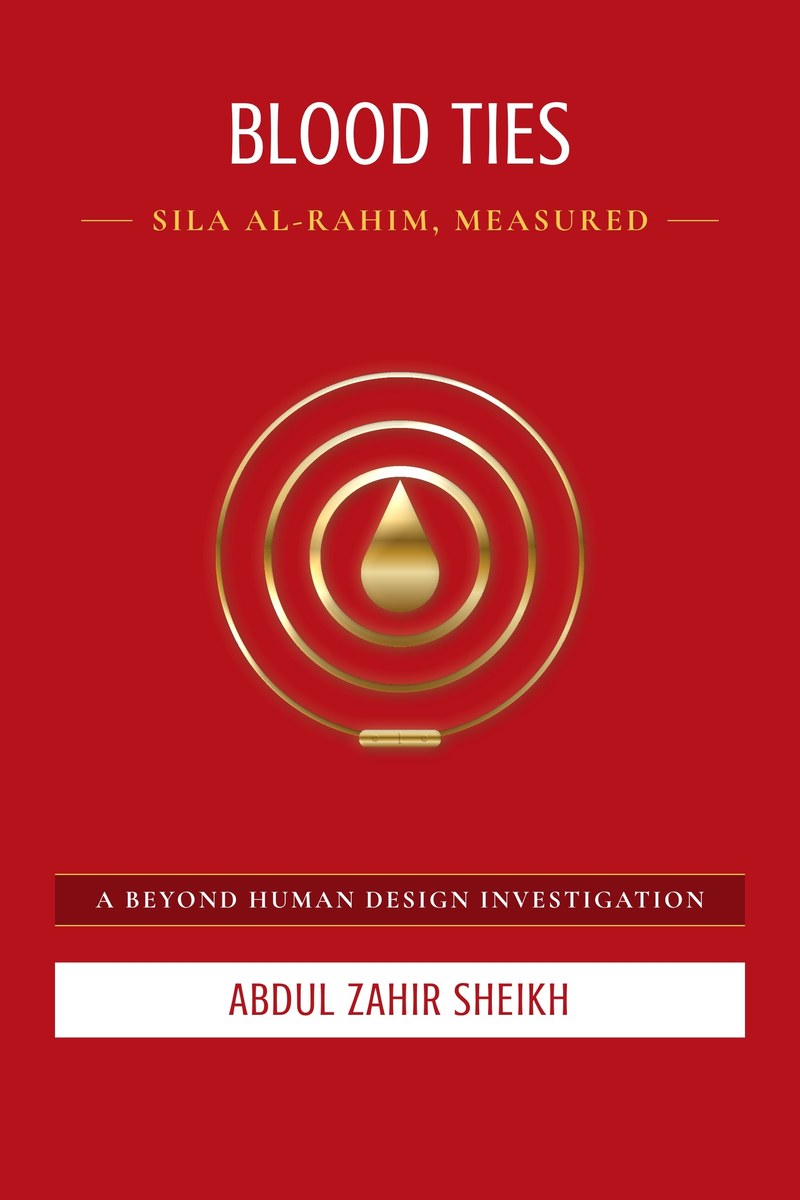
Blood Ties
Three Circles · Five Pillars · Forty Points
Sila al-Rahim, Measured
Every family keeps a record of its ties, in calls, visits, gifts and silences. Three circles of kin, five pillars, forty points on two maps, evidence for every score, and a Safety Gate first.
- Paperback
- 978-9914-776-62-1
- Hardcover
- 978-9914-776-61-4
- eBook
- 978-9914-776-60-7
- Audiobook
- Coming soon
The book in ten slides
About three minutes; each slide stays up long enough to read
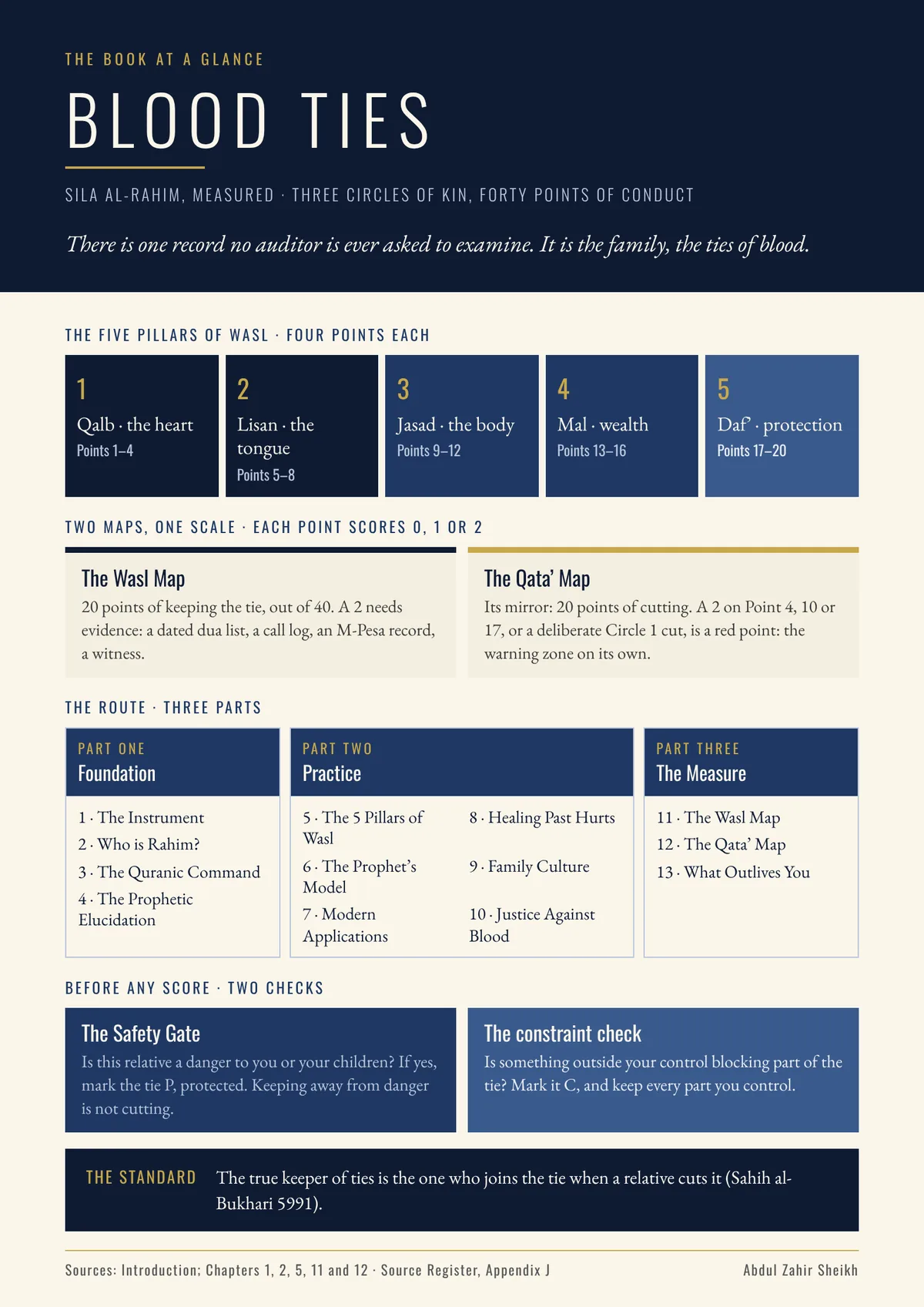
The book at a glance
One page: the structure, the measure and the standard
About the book
Every family keeps a record of its ties. Each member keeps his own, in his calls, his visits, his giving and his silences. This book audits that record, and the only member it examines is the reader.
The Quran commands the believer to fear Allah, through whom you ask of one another, and the wombs (4:1). The Prophet ﷺ said that the bond of kinship hangs from the Throne: Allah keeps whoever keeps it, and cuts whoever cuts it. Yet the verse recited at the start of a marriage is rarely remembered at the end, when an estate has not been shared, a sister has been removed from the family group, or two brothers have not spoken since their father’s funeral.
A forensic examiner with four decades of investigations behind him knows that fraud does not announce itself. It shows in conduct, and no single sign proves anything. The ties of blood are read the same way. One hadith sorts all conduct into three kinds: the one who joins, the one who only returns what he is given, and the one who cuts.
Three circles. Five pillars. Forty points on two maps.
The Wasl Map scores twenty points of keeping the ties under five pillars: the heart, the tongue, the body, wealth, and protection and justice. The Qata’ Map scores twenty points of cutting. Three circles of kin set the standard of contact, from parents and children to distant relatives. You score the last three months, on what you did rather than what you feel, and a score of 2 needs evidence: a dated dua list, a call log, a mobile-money record, a witness.
The case rests on eleven verses and nine hadith, each named by collection and number. A claim of curse, of deeds not accepted or of Paradise barred is made only on a narration graded sahih or hasan, and the book states in advance what would prove it wrong.
Justice even against blood. Distance from harm is never scored as cutting.
A family that protects the brother who withholds his sisters’ shares has not kept the tie. It has helped the oppressor. A full chapter applies 4:135 and 5:8, and an inheritance worksheet tests whether every share has reached its owner. The Safety Gate comes before any score: a relative who is a danger is kept at a protected distance, and the person harmed owes that relative only honesty.
Written by Abdul Zahir Sheikh, a Certified Fraud Examiner and Senior Partner at BDO East Africa with four decades of investigative experience across fourteen countries, with a foreword by Sheikh Abdurrahman Ishaq, Imam of Parklands Mosque in Nairobi, it is a workbook meant to be used: three to six hours for a first audit, under an hour each quarter after that. Scores stay private, and a score is never a verdict on anyone’s standing with Allah.
A tie that was cut can still be joined. Go first.
More books
 The Quran’s Hidden Architecture
 The Googol Verdict
 The Creator’s Signature on the World He Made
 Knowing the Creator
 The Authentication Test
 The Origination Map
 The Common Source
 The Network of Truth
 The Zakat Theorem
 The Crucifixion File
 The Just Law
 The Absolute Benchmark
 The Just Creator
 One Creator, One Humanity
 The Sound Heart
 The Leadership Evidence Map
 Business Results at the Speed of AI
 The Incentive File
 The Board’s Evidence
 The Whistleblower’s File
 The Ramadan Experiment
 The Settled Account
 Finishing Strong
 Under One Roof