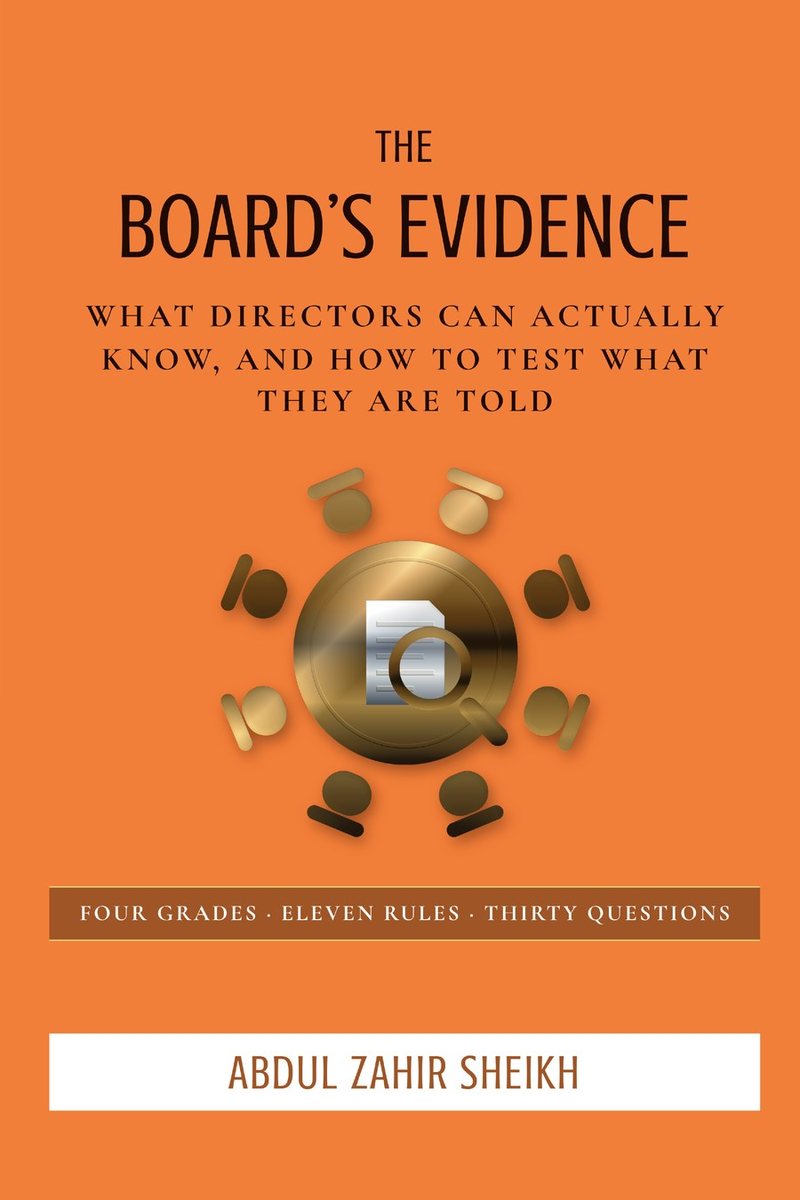
The Board’s Evidence
Four Grades · Eleven Rules · Thirty Questions
What Directors Can Actually Know, and How to Test What They Are Told
Most of what a board is told comes from the people it oversees. Four grades, eleven rules and a thirty-question audit show what a board was actually told.
- Paperback
- 978-9914-776-59-1
- Hardcover
- 978-9914-776-58-4
- eBook
- 978-9914-776-57-7
The book in ten slides
About three minutes; each slide stays up long enough to read
About the book
Every board decides on what it is told. Most of what it is told comes from the people it is meant to oversee.
That is not a flaw in any one company. It is how boards are built: the directors meet for a few days a year, and the executives run the business every day. This book does not ask whether a board was diligent, independent or well chaired. It asks what the board had in front of it, who produced it, and whether anyone outside management had tested it.
Those questions can be answered from records. The Board Evidence Grade sorts every material claim in a board pack into four grades, A to D, under eleven rules, with a mark for what the pack leaves out. Applied to the published minutes of five Carillion board meetings in 2017, it found 33 material claims. Seven reached grade B. None reached grade A.
The board was not deceived by one false report. It governed on a single source, and that source failed.
The same grade is turned on five boards that failed — Carillion, Imperial Bank, Chase Bank, Wirecard and Steinhoff — and on Tesco, whose board caught a problem within weeks. In all five failures, the warning existed in the organisation’s records before the collapse. The book shows where it sat, and what the board actually received.
It then examines six sources of evidence an organisation already holds: its own auditors, the people who raise concerns, customers and regulators, the staff who hold the numbers, the letters addressed to the board, and the cash and commitments behind the accounts.
Each question names the document that answers it. No document, no score.
The final part turns the findings into a standard: what boards did when better evidence arrived, the minutes as the record of what a board did with it, what the law in five jurisdictions asks of a director who relies on others, and the Board Evidence Audit, thirty questions in six domains, each scored from a document, for a total of 90.
Written by Abdul Zahir Sheikh, a Certified Fraud Examiner and Senior Partner at BDO East Africa with four decades of investigative experience across fourteen countries, it is written for directors, chairs, company secretaries and audit committee members, and for the heads of internal audit, risk and compliance who serve them.
Stop governing on management’s account. Start grading it.
More books
 The Quran’s Hidden Architecture
 The Googol Verdict
 The Creator’s Signature on the World He Made
 Knowing the Creator
 The Authentication Test
 The Origination Map
 The Common Source
 The Network of Truth
 The Zakat Theorem
 The Crucifixion File
 The Just Law
 The Absolute Benchmark
 The Just Creator
 One Creator, One Humanity
 The Sound Heart
 The Leadership Evidence Map
 Business Results at the Speed of AI
 The Incentive File
 The Ramadan Experiment