Finishing Strong
Five Pillars · Twenty Questions · Eight Rules
Deeds Judged by Their Endings
The Prophet ﷺ said that deeds are judged by their endings. A forensic self-audit of the ending: five pillars, twenty questions, an Ending Map, a Risk Map and eight rules, every hadith graded.
- Paperback
- 978-9914-776-68-3
- eBook
- 978-9914-776-67-6
- Audiobook
- Google Play
The book in ten slides
About three minutes; each slide stays up long enough to read
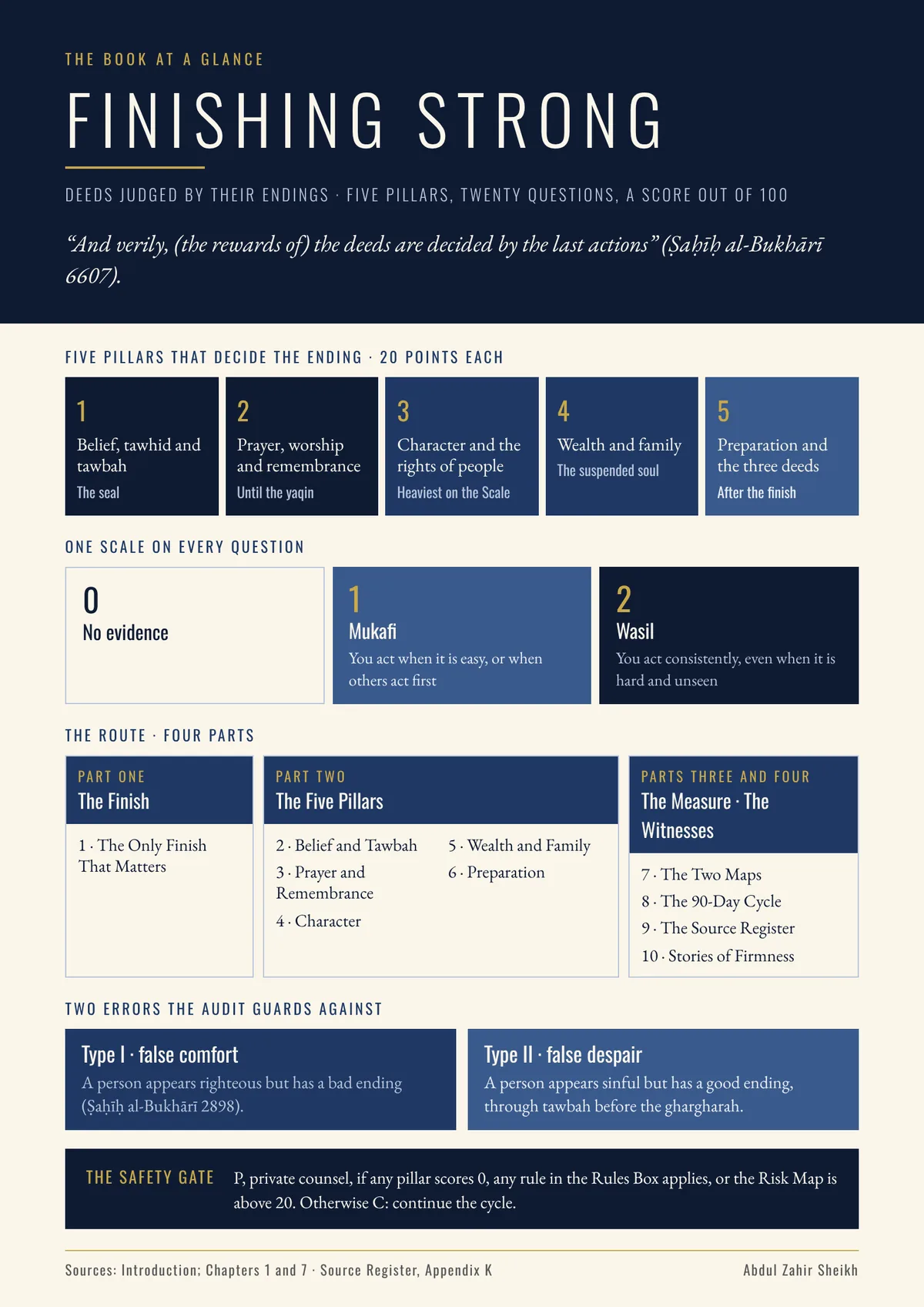
The book at a glance
One page: the structure, the measure and the standard
About the book
The Prophet ﷺ said that deeds are judged by their endings. This book audits the ending the way a fraud examiner audits anything else: by evidence, while there is still time to act on it.
In Nairobi, in Dubai and in London, professionals audit procurement contracts, financial statements and KPIs. They do not audit their own ending. The will they have meant to write for years is still unwritten. No register of their debts exists. Their families have never been taught what to say, and what not to say, at the bedside. Each carries the same lengthy hope: I will repent later, I will write the will later, I will restore the tie later.
The instrument is built before any reader is scored. Five pillars: belief and sincere repentance; prayer, worship and remembrance; character and the rights of people; wealth and family; preparation and the three continuing deeds. Each pillar has four questions scored 0, 1 or 2, and for each pillar the book states in advance what would show that you are not finishing strong.
Two errors. One flatters you. The other makes you despair.
A man who fought bravely beside the Muslims looked like one of the people of Paradise, then took his own life when the pain came. That is the false comfort. A sinner who repents sincerely before the soul reaches the throat has his evil deeds replaced with good. That is the false despair. The audit guards against both, and both protections work only before the deadline.
Above the arithmetic sit eight rules, each resting on a text: the soul is held by its debt, haram nourishment blocks supplication, a bequest beyond one-third made to harm the heirs must be corrected. An Ending Map of twenty signs, built on the signs of a good ending that al-Albānī authenticated, faces a Risk Map of twenty barriers. A Safety Gate decides when a score calls for private counsel rather than a quarterly plan.
Every hadith carries its collection, its number and its grading. A weak narration is never used as proof.
Written by Abdul Zahir Sheikh, a Certified Fraud Examiner and Senior Partner at BDO East Africa with four decades of investigative experience across fourteen countries, with a foreword by Sheikh Abdurrahman Ishaq, Imam of Parklands Mosque in Nairobi, this is a workbook to be used as well as read. A 90-day cycle turns each score into action, and eight forms carry the work: the Start Sheet, the Scorecard, the Debt and Rights Register, the Wasiyyah Worksheet, the Last Words Sheet, the Quarterly Tracker, the Kinship Map and the Wealth Audit. The scores are private, the trend matters more than any single result, and the verdict on any soul belongs to Allah alone.
Take account of yourself before you are taken to account. Then give your best at the finish.
More books
 The Quran’s Hidden Architecture
 The Googol Verdict
 The Creator’s Signature on the World He Made
 Knowing the Creator
 The Authentication Test
 The Origination Map
 The Common Source
 The Network of Truth
 The Zakat Theorem
 The Crucifixion File
 The Just Law
 The Absolute Benchmark
 The Just Creator
 One Creator, One Humanity
 The Sound Heart
 The Leadership Evidence Map
 Business Results at the Speed of AI
 The Incentive File
 The Board’s Evidence
 The Whistleblower’s File
 The Ramadan Experiment
 The Settled Account
 Under One Roof
 Blood Ties