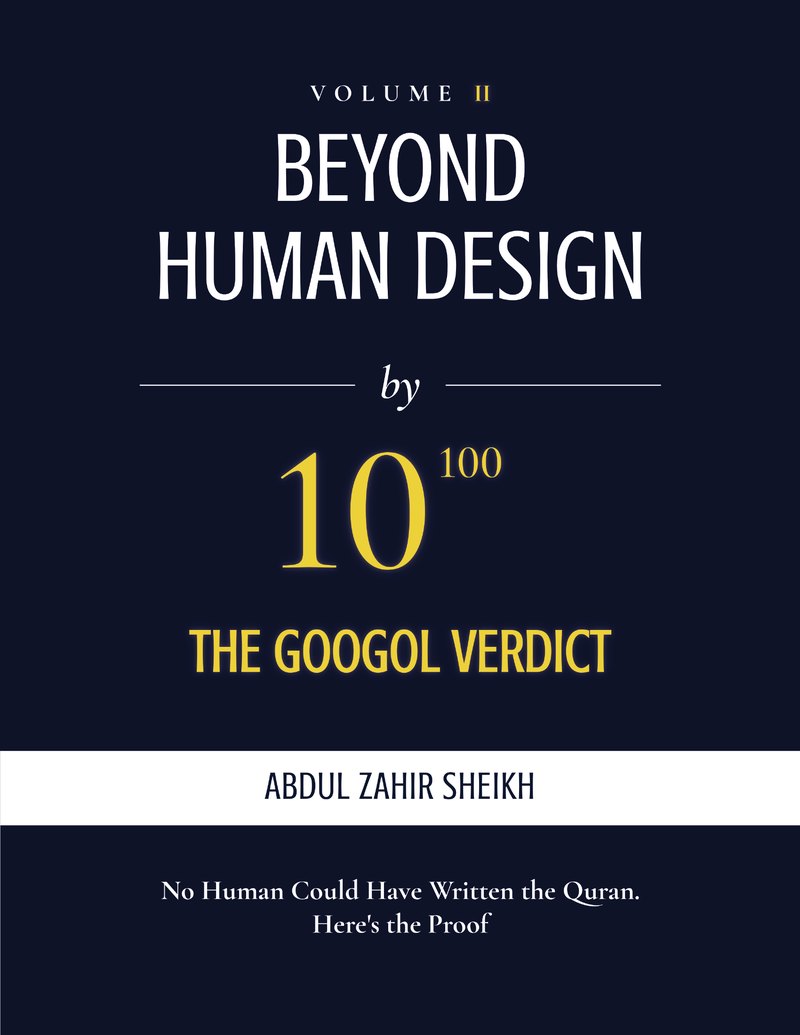
Volume II
The Googol Verdict
No Human Could Have Written the Quran. Here’s the Proof
Volume I ruled out every human author. Volume II calls twenty-two new witnesses, without a single calculation, and draws the portrait of the Author who is left.
- Paperback
- 978-9914-776-04-1
- Hardcover
- 978-9914-776-03-4
- eBook
- 978-9914-776-05-8
The book in ten slides
About three minutes; each slide stays up long enough to read
About the book
The mathematics ruled out every human author. This book asks the harder question: if not a man, then who?
Volume I of Beyond Human Design measured the Quran’s architecture and found the odds against human authorship past a googol. A reader who does not trust a probability calculation has nowhere to stand inside a book made of them. So this volume reaches the same verdict a second time, by a different road, and without a single calculation of its own.
Twenty-two witnesses give evidence, across nine movements: computational stylometry, grammatical parsing, corpus frequency, information theory, Arabic prosody, topology, fractal patterns in language, textual criticism, and the documented history of the text’s transmission. Every one is a published study, by researchers with no stake in the question this book asks. Each is read at its most cautious, and each is tested against what a human author could have produced.
A case that survives without its own mathematics is a different kind of case.
The architecture is held to the standards of blind ring-detection and a published chance test, and meets them. A style is measured that holds steady across twenty-three years. A book with no second draft and no verified contradiction is held by heart across fourteen centuries and matched, word for word, to its oldest surviving pages. A standing challenge to produce even one chapter like it goes unmet.
Then the volume does something stranger. Evidence gathered to answer a narrow question about authorship turns out, laid side by side, to describe the author. Consider how an investigator rebuilds a suspect from the marks he leaves: a hand, a habit, a range of knowledge, a way of working. The witnesses were never asked to draw a portrait. The volume shows what happens when they draw one anyway, and then sets that portrait beside the description the text gives of its own Author. The two match.
The volume is equally plain about its limits. Where a witness rests on a single study, it says so. Where a finding has been challenged in the literature, the challenge is entered at full strength before the reply. Where two witnesses draw on the same evidence, they are counted once. The aim is a portrait that a sceptical reader could redraw for himself, from the same sources, and arrive at the same face.
Rule out every human hand, and what remains is not an empty chair. It is a face.
The portrait is of an Author who commands every register of a language He never had to study, who speaks from outside time and error, and who built a text to survive the harshest scrutiny a book can face. It is not a doctrine. It is a reconstruction, assembled from evidence, and every witness carries its source so that each feature can be checked.
The witnesses are grouped into nine movements, so that a reader can follow the case discipline by discipline: the statistics of style; the grammar and vocabulary; the measures of information and compression; the sound of the text and its rhythm; the shapes in its structure; and the long record of how it was written down, recited and preserved. Each movement ends by stating what it has added to the portrait, and what it has not.
Written by Abdul Zahir Sheikh, a Certified Fraud Examiner and Senior Partner at BDO East Africa with four decades of investigative experience across fourteen countries, this second volume of Beyond Human Design turns the verdict of the first into an identification.
Twenty-two witnesses. Nine disciplines. One face.
More books
 The Quran’s Hidden Architecture
 The Creator’s Signature on the World He Made
 Knowing the Creator
 The Authentication Test
 The Origination Map
 The Common Source
 The Network of Truth
 The Zakat Theorem
 The Crucifixion File
 The Just Law
 The Absolute Benchmark
 The Just Creator
 One Creator, One Humanity
 The Sound Heart
 The Leadership Evidence Map
 Business Results at the Speed of AI