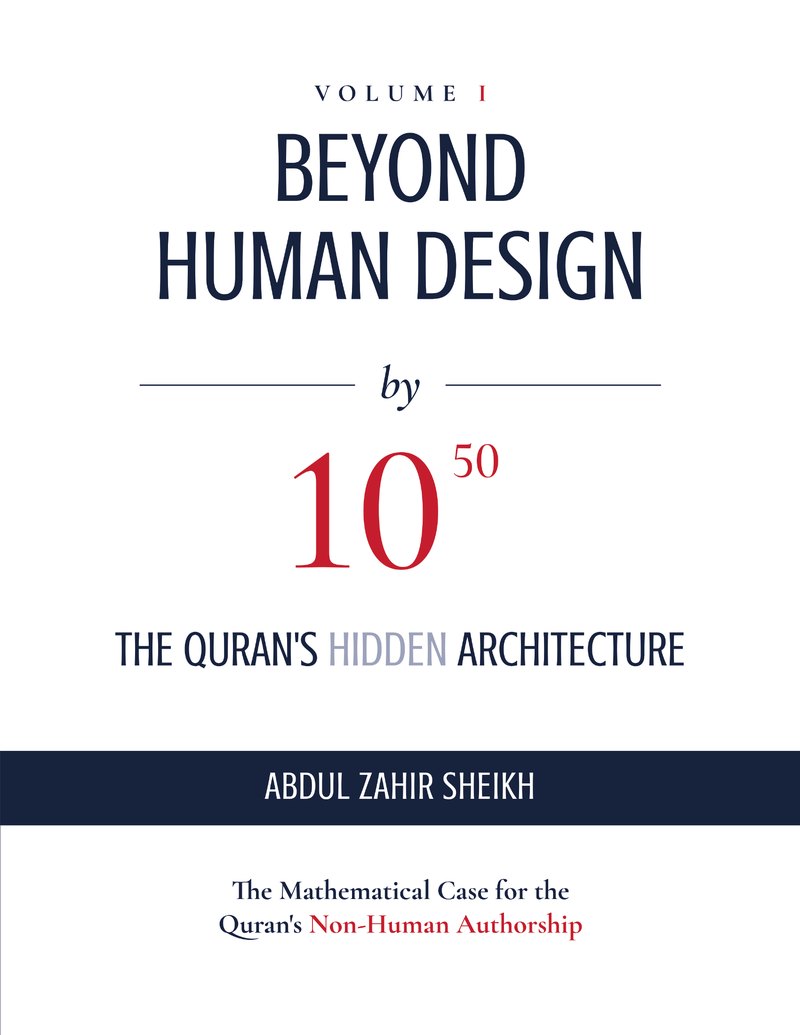
Volume I
The Quran’s Hidden Architecture
The Mathematical Case for the Quran’s Non-Human Authorship
An unlettered man, twenty-three years, no pen, and a book built in nested rings. A forensic auditor measures the Quran’s architecture and prices it against chance.
- Paperback
- 978-9914-776-01-0
- Hardcover
- 978-9914-776-00-3
- eBook
- 978-9914-776-02-7
The book in ten slides
About three minutes; each slide stays up long enough to read
About the book
An unlettered man. Twenty-three years. No pen. And a book built like nothing a human hand has made. This book asks how, and answers with arithmetic.
For fourteen centuries the Quran’s claim to a non-human origin has met one of two answers: faith or dismissal. This book takes neither route. It treats the claim as a case and works it the way a forensic auditor works a fraud: the rules fixed first, the evidence measured, every alternative heard at its strongest, and nothing taken on trust.
The Quran was delivered aloud, in pieces, over twenty-three years, in answer to events no one could plan for, by a man who could not read or write. Yet its chapters are built as concentric rings, from a single verse to a chapter of 286, each second half mirroring the first around a pivot. Its 114 chapters fall into fifty-three paired mirrors. Its style does not drift across two decades of upheaval. Eleven independent findings are set out, each measured, and each tested against what an ordinary author working under those conditions could produce.
You have been told this is a matter of faith. It is a matter of arithmetic.
The findings are priced against chance with published methods, and always at their most cautious reading. Two witnesses alone reach one in 10⁵⁰, the odds of marking one atom somewhere on Earth and finding it blindfold at the first reach. Five witnesses together reach one in 10⁷⁵. The architecture alone, on its full model, passes a googol. Every figure is shown with its working, every assumption is named, and the complete ledger of chapters is printed, flattering and unflattering alike, so that a hostile reader can run the sieve himself.
Consider how a forensic examiner treats a document said to be the unaided work of one person. He asks whether the conditions of its making could produce what is in front of him. Six human explanations are then put in the dock: copying from earlier scripture, private instruction, borrowing from Persian or Greek sources, a secret committee, later fabrication, and deliberate deception. Each is stated at full strength, and each is discharged on the evidence.
The volume is strict about what it counts. A ring enters the evidence only when scholars working independently map it the same way, and the cautious figure is built from those rings alone. The broader patterns, the paired chapters among them, are weighed as corroboration and never added to the price. Where the evidence is contested, the contest is printed beside the figure, not in a footnote at the back.
You can walk out on a sermon. It is far harder to walk out on a calculation.
This is the first volume of Beyond Human Design, a four-volume investigation that goes on to draw the portrait of the Author, to test the Quran’s statements about the physical world, and to set out what that Author has said. This volume is where the case begins: with a structure no human hand, working under those conditions, could have built.
The book is written for the believer who wants to know what the evidence shows, for the sceptic who suspects that the patterns are read into the text, and for the general reader who has never been shown the case at all. No mathematics beyond arithmetic is assumed. Every calculation is carried out in front of the reader.
Written by Abdul Zahir Sheikh, a Certified Fraud Examiner and Senior Partner at BDO East Africa with four decades of investigative experience across fourteen countries, this is the book that brings the oldest question about the Quran into the examiner’s room and leaves it on the record, measured.
Measure the architecture. Price it against chance. See what remains standing.
More books
 The Googol Verdict
 The Creator’s Signature on the World He Made
 Knowing the Creator
 The Authentication Test
 The Origination Map
 The Common Source
 The Network of Truth
 The Zakat Theorem
 The Crucifixion File
 The Just Law
 The Absolute Benchmark
 The Just Creator
 One Creator, One Humanity
 The Sound Heart
 The Leadership Evidence Map
 Business Results at the Speed of AI