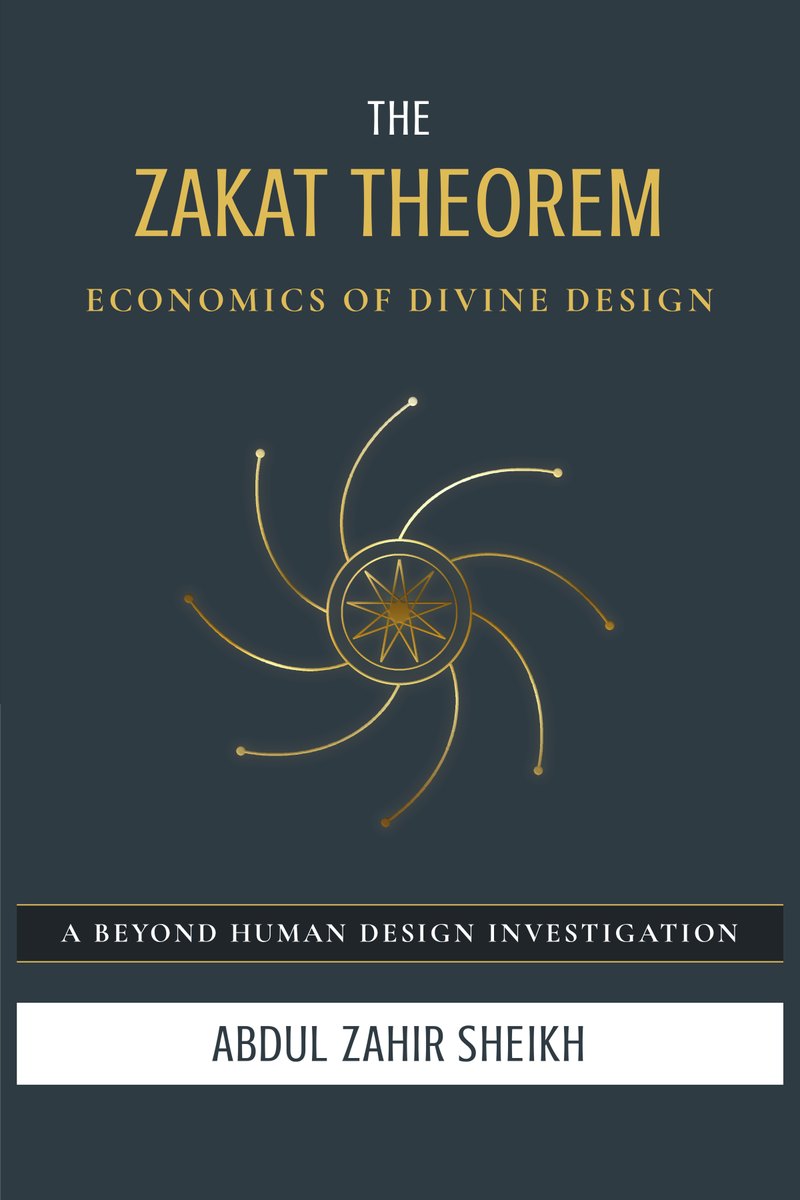
The Zakat Theorem
Economics of Divine Design
A Seventh-Century Wealth System, Tested Against Modern Economics
Zakat, the inheritance shares and the ban on riba, tested with game theory, mechanism design and fifty-year simulations of whole economies. The code is printed in full.
- Paperback
- 978-9914-776-09-6
- Hardcover
- 978-9914-776-10-2
- eBook
- 978-9914-776-11-9
The book in ten slides
About three minutes; each slide stays up long enough to read
About the book
Generosity and optimality are two different things. A wealthy benefactor can give a great deal and still design a terrible system. This one did not.
A system can be large and still inefficient: creating wrong incentives, concentrating resources rather than circulating them, or collapsing under stress. An optimal system does none of these things. This book measures the Quran’s economic law against that standard, with the tools twenty-first-century economics uses to judge any economic design: game theory, mechanism design, optimal tax theory and agent-based simulation of whole economies over fifty years.
Four domains are tested. Zakat, with the rate and threshold the Prophet ﷺ fixed and the eight categories of recipient in the Quran. Inheritance, under the fractional shares of the fourth chapter. The prohibition of riba. And the major strategic decisions of the mission, from the migration to Abyssinia to the Treaty of Hudaybiyya and the Constitution of Medina. The claim is narrow and stated at the outset: the prescriptions were correct before the tools existed to prove them correct. The Quran does not contain game theory, and Islam did not invent modern economics.
A system can be generous by accident. It cannot be optimal by accident.
The results are measured, not asserted. In the simulation, inequality rises on its own from a Gini of 0.65 to 0.786 over fifty years. Zakat brings it down to 0.380 and lifts the poorest tenth’s share of wealth sevenfold. The 2.5 per cent rate sits inside the 2–4 per cent band that a modern stability condition requires. Applied to real families across generations, the Quranic inheritance shares leave a society less unequal than any other rule tested, primogeniture included. The riba prohibition removes the mechanism by which debt outgrows income.
Consider how an auditor treats a model he is asked to rely on. He wants the assumptions printed, the code available, and the result reproducible. Every model, every parameter and every line of the simulation code is printed in the appendices, and the random seeds are fixed, so that any reader with a laptop obtains the same numbers. Each domain carries its own grade: zakat and inheritance strong, the strategic decisions and the riba prohibition supporting. They are weighed, never multiplied into one figure.
Where a result does not hold, the book says so, in the chapter and in the verdict.
Agreement of this kind, in four domains, in a seventh-century text, would itself need explaining. The book stands on the verdict of Volumes I to IV of Beyond Human Design: the Quran’s Author is the Creator of the world these prescriptions govern, and that verdict explains the agreement. The book then measures it, domain by domain, and weighs whether chance could produce it instead.
Half a community paying zakat, the simulations show, still matches a fully applied 1.5 per cent wealth tax: the system degrades gradually rather than collapsing, which is what a well-designed mechanism should do.
Every figure is stated at the strength the evidence supports, and no more.
Written by Abdul Zahir Sheikh, a Certified Fraud Examiner and Senior Partner at BDO East Africa with four decades of investigative experience across fourteen countries, this is the book that tests a body of economic law more than a billion people hold sacred by the same mathematics economists apply to every other question of design.
Run the mechanism through the mathematics. Explain how it arrived at the optimum.
More books
 The Quran’s Hidden Architecture
 The Googol Verdict
 The Creator’s Signature on the World He Made
 Knowing the Creator
 The Authentication Test
 The Origination Map
 The Common Source
 The Network of Truth
 The Crucifixion File
 The Just Law
 The Absolute Benchmark
 The Just Creator
 One Creator, One Humanity
 The Sound Heart
 The Leadership Evidence Map
 Business Results at the Speed of AI