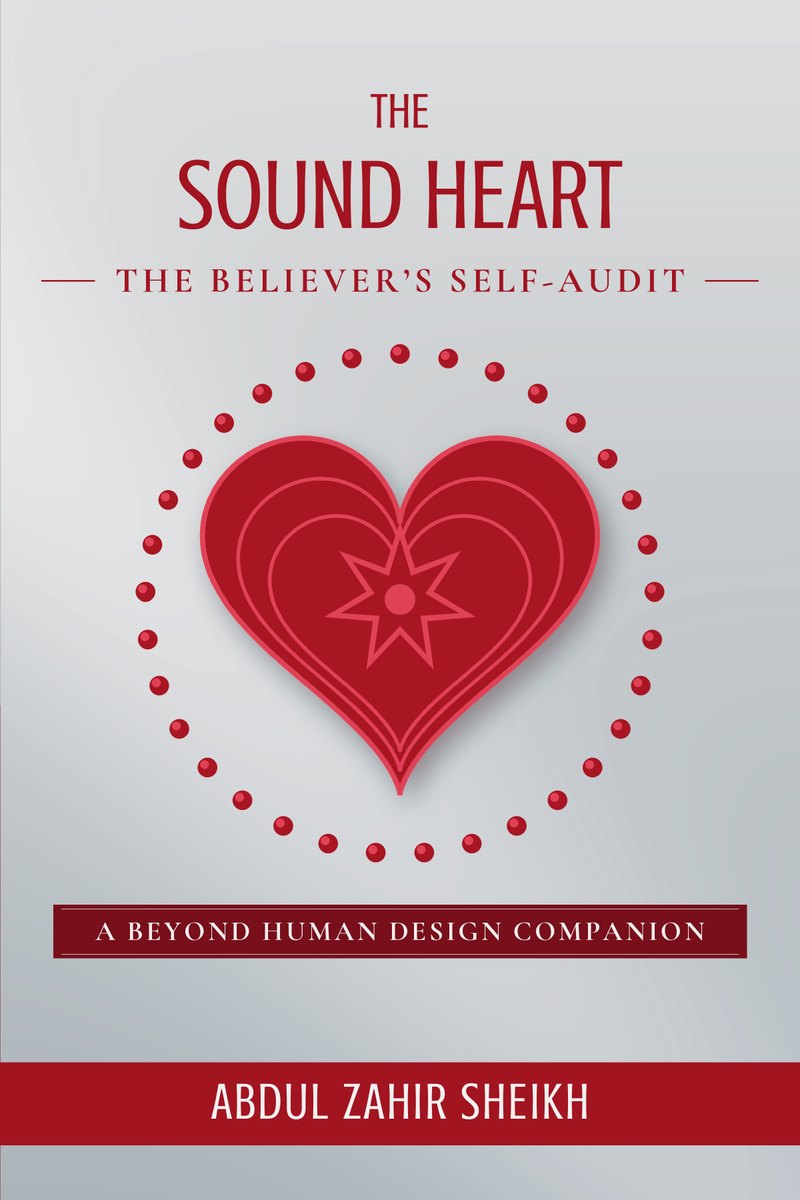
The Sound Heart
The Believer’s Self-Audit
Thirty-Three Conditions of the Heart, Each Traced Through the Conduct That Proves It
Can you audit your own heart? Thirty-three conditions, each set out as the conduct that proves or disproves it, sourced in the Quran and Sunnah, with a ninety-day plan.
- Paperback
- 978-9914-776-43-0
- Hardcover
- 978-9914-776-42-3
- eBook
- 978-9914-776-44-7
The book in ten slides
About three minutes; each slide stays up long enough to read
About the book
You can audit a company, a ledger or a claim. This book asks whether you can audit your own heart, and what the evidence would show if you did.
The Quran is plain about what will count on the Day when neither wealth nor children can help: coming to Allah with a sound heart (26:88–89). Yet most believers examine only what can be counted: prayers, fasts, zakat. The heart is left to feeling, and feeling is the most generous witness a person will ever call. A forensic examiner never sees intent. Courts reconstruct it from conduct. This book applies that method to the inner life.
It takes the method the Prophet ﷺ used when he named hypocrisy by its signs: an inner condition, traced through conduct. Thirty-three conditions of the heart, under seven pillars, are each set out with the disease and its cure, and with the conduct that shows the cure beside the conduct that shows the disease. Every behaviour carries its source in the Quran, the Sunnah or the classical scholars, and where a text is applied to a situation of our own time, the book says so.
A self-report is not evidence. Conduct is. The heart shows itself in what it does.
You score yourself from a sample of what you actually did, the last five occasions or five consecutive days, not from how you feel. Then you ask the examiner’s hardest question: would this have been different if someone had been watching? The book names the eight excuses that account for most of what an honest audit finds, each with its classical name and its Quranic answer, drawing on al-Ghazālī’s study of self-delusion and on the modern study of how people talk themselves past their own conduct.
Consider what an audit is for. It is not a verdict; it is the start of a correction. Every finding is carried into repentance, restitution where a right is owed to another person, and a ninety-day plan built on al-Ghazālī’s stations of self-accounting, with five priorities chosen, because the deeds most beloved to Allah are the most regular, even if few.
The verdict on the heart belongs to Allah. The audit is yours.
The book builds three guards. Against scrupulosity: it never examines passing thoughts, and it tells the reader overwhelmed by doubts to stop and seek help. Against despair: a low score is a finding, not a verdict, and the door of return stays open. Against complacency: a high score is a reason for gratitude and for testing again. It forbids turning the audit on anyone else. Its standards rest on the verdict of Volumes I to IV of Beyond Human Design, so they are the standards of the One who will read the record of the heart.
It is written for the believer who wants to know where he stands, and it asks for about eight hours over a week, one pillar a day, a private workbook, and if he chooses, one truthful and discreet friend.
The method comes from the tradition itself: the Prophet’s ﷺ description of hypocrisy through its signs, al-Ghazālī’s stations of self-accounting, and the saying reported from ʿUmar, take account of yourselves before you are taken to account. Where a narration is weak, the book sets it aside, even when it would have served.
Written by Abdul Zahir Sheikh, a Certified Fraud Examiner and Senior Partner at BDO East Africa with four decades of investigative experience across fourteen countries, with a foreword by Sheikh Abdurrahman Ishaq, this is the book that brings the discipline of the audit to the one file no auditor can reach.
Examine the heart while there is still time to change it.
More books
 The Quran’s Hidden Architecture
 The Googol Verdict
 The Creator’s Signature on the World He Made
 Knowing the Creator
 The Authentication Test
 The Origination Map
 The Common Source
 The Network of Truth
 The Zakat Theorem
 The Crucifixion File
 The Just Law
 The Absolute Benchmark
 The Just Creator
 One Creator, One Humanity
 The Leadership Evidence Map
 Business Results at the Speed of AI