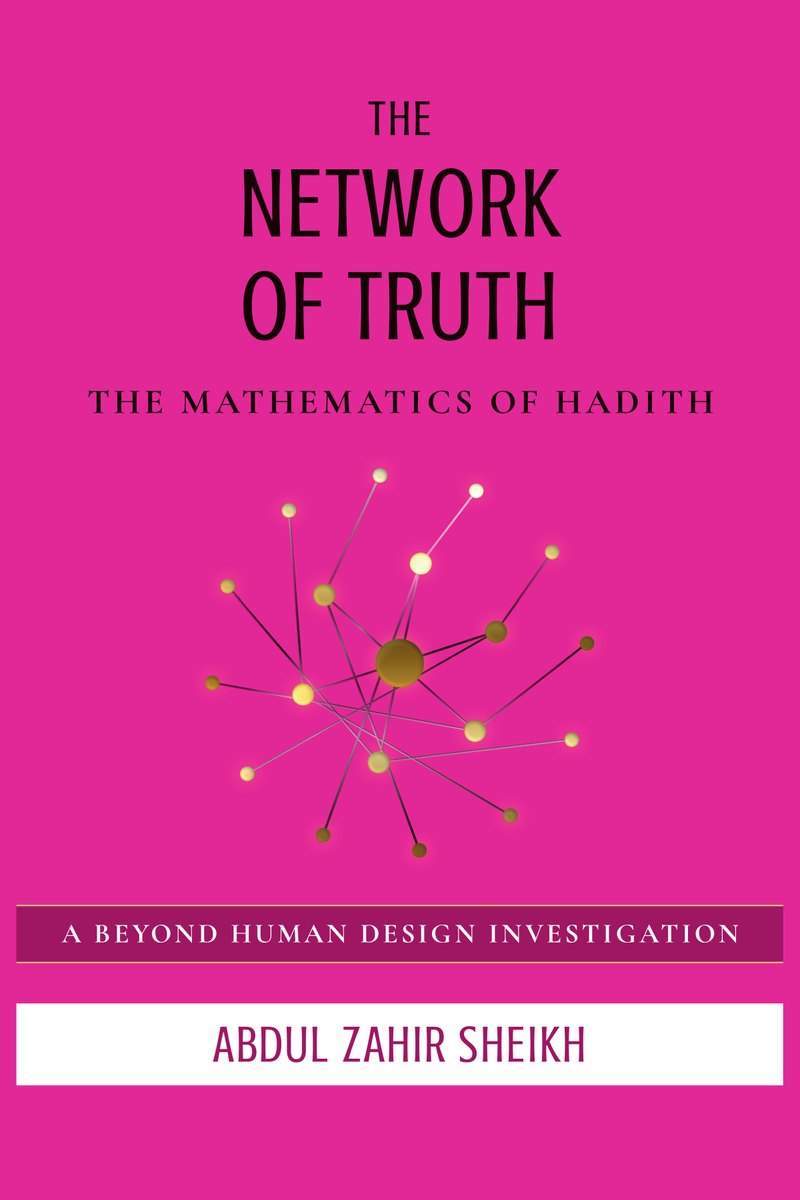
The Network of Truth
The Mathematics of Hadith
Graph Theory, Social Network Analysis, and the Mathematical Case for Hadith Authenticity
The Hadith scholars recorded who passed what to whom. This book analyses that record as a network, with the tools used to detect fraud, and asks which signature it carries.
- Paperback
- 978-9914-776-06-5
- Hardcover
- 978-9914-776-08-9
- eBook
- 978-9914-776-07-2
The book in ten slides
About three minutes; each slide stays up long enough to read
About the book
Every profession eventually develops a standard of proof. The Hadith scholars built theirs fourteen centuries before the professions had a name for it.
In medicine it is the randomised controlled trial; in law, the burden of proof on the accuser; in financial investigation, the documented chain from source to conclusion. The scholars of narrators built something that belongs on that list: a record of tens of thousands of named transmitters, of who heard what from whom, with criteria for every link, designed to expose fabrication. In the language of modern mathematics, what they built is a graph, and graphs can be analysed.
This book analyses it. It builds the network from published, open datasets, more than eighteen thousand named narrators joined by over a hundred and twenty-six thousand recorded links, and checks it again on a second corpus of more than a quarter of a million names. The tools are the ones that test whether a financial network carries the footprint of genuine transactions or of fabrication, the same tools that expose manipulated citation networks and coordinated online campaigns.
You were told Hadith authentication was piety. The graph shows that it was also mathematics.
Nine tests ask which signature the record carries. Does the network find the tradition’s central narrators on its own? Does its measure of authority track the grades the classical scholars assigned? Is it clustered the way genuine communities are? Do its chains respect chronology and geography? Each test is measured against a published baseline, two are decisive, four corroborate, and the weakest is named as such. The nine are weighed as a jury would weigh them, never multiplied into one inflated figure.
Consider what fabrication on a large scale would require: hundreds of thousands of invented links, each plausible in time, place and biography, each consistent with every other, and the whole reproducing the clustering of a living scholarly community. The book sets four versions of the fabrication hypothesis against the data, from the whole corpus invented down to individuals inventing individual reports, and answers the scholars who argued for it, Joseph Schacht among them, by name.
A forged network cannot reproduce the marks of organic growth. This one carries them.
The finding is about the transmission system as a whole. Each report is still judged on its own chain and text, as the scholars of Hadith always required, and the book says so at every step. Every dataset and every figure is public, so that a sceptical reader can rerun the tests. The book stands on the verdict of Volumes I to IV of Beyond Human Design: the Quran gives the Prophet ﷺ his place, so his words matter, and the faithfulness of their transmission is a question worth testing.
The book is written for three readers: the Muslim scholar who wants to see the mathematics of a tradition he already knows; the sceptic who believes the Hadith are a medieval fabrication; and the general reader. It assumes no mathematics, derives every formula from first principles, and teaches the tools before using them.
Every dataset is open, and every test can be rerun.
Written by Abdul Zahir Sheikh, a Certified Fraud Examiner and Senior Partner at BDO East Africa with four decades of investigative experience across fourteen countries, this is the book that brings network science to the oldest chain-of-custody system in the world.
Graph the network. Measure the convergence. The mathematics has a verdict.
More books
 The Quran’s Hidden Architecture
 The Googol Verdict
 The Creator’s Signature on the World He Made
 Knowing the Creator
 The Authentication Test
 The Origination Map
 The Common Source
 The Zakat Theorem
 The Crucifixion File
 The Just Law
 The Absolute Benchmark
 The Just Creator
 One Creator, One Humanity
 The Sound Heart
 The Leadership Evidence Map
 Business Results at the Speed of AI