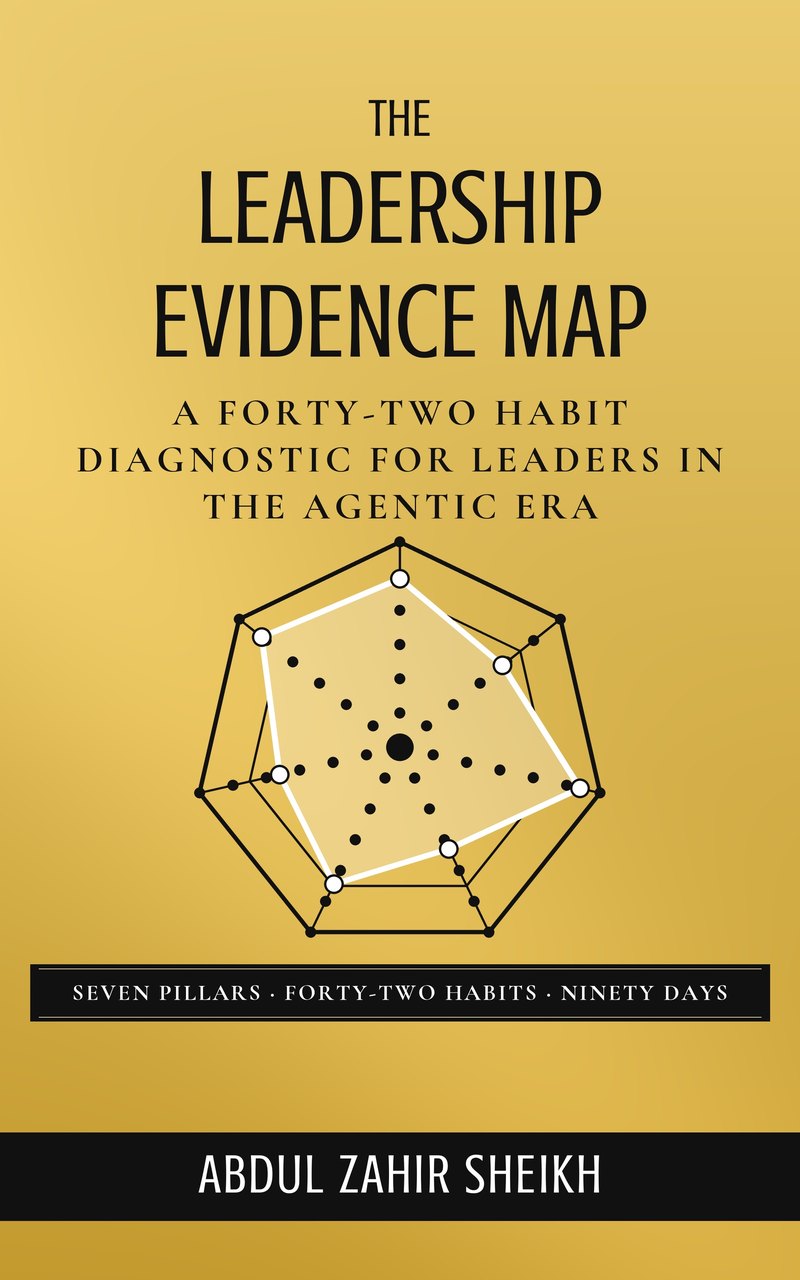
The Leadership Evidence Map
A Forty-Two Habit Diagnostic for Leaders in the Agentic Era
Seven Pillars, Five Behaviours For and Five Against, and a 90-Day Plan to Close the Gap
Forty-two leadership habits, each set out as behaviours that prove or disprove it. Score yourself on what you can show you did, then work a ninety-day plan.
- Paperback
- 978-9914-776-46-1
- eBook
- 978-9914-776-45-4
The book in ten slides
About three minutes; each slide stays up long enough to read
About the book
Ask any leader whether they listen, delegate or keep their word, and the answer will almost always be yes. Ask their team, and you may hear something different.
Most leadership books describe the leader you would like to be. This one measures the leader you are. It breaks leadership into forty-two habits across seven pillars, from personal mastery and sustainability, through people leadership and hybrid trust, execution in automated workflows, decision-making that interrogates the algorithm, influence and digital trust, and growth and sustainability, to the governance of AI and cybersecurity.
Each habit is set out as five behaviours that prove it and five that disprove it, with an evidence prompt that tests your score and a note of the research behind the habit. The sources are graded, from peer-reviewed and official studies to consultancy surveys, and every statistic is traced as close as the public record allows to the source that first reported it. Where a number is the author’s guide from practice rather than a research finding, the book says so.
A self-report is not evidence. Conduct is. The score is not softened. It is used.
You score yourself on what you can show you did, with a dated instance for each behaviour, against a total of two hundred and ten. The count decides the score: five behaviours shown earn a five, four a four. A total can hide a dangerous gap, so any score of one on the habits that guard the organisation, such as automation integrity and cyber-resilient culture, is treated as a finding however high the total. Your team can score the same habits from conduct they have already seen, and any gap of more than a point is a finding to investigate.
Consider how a forensic examiner treats a person’s account of their own conduct: as the weakest kind of evidence. That is not because people lie. It is because they remember selectively, in their own favour. Every low score is carried into a ninety-day plan, each action tied to a set moment in your week, and tested again at the end, so that progress is measured rather than claimed. The plan is built on the research on how habits form and how intentions turn into action.
In an age of intelligent agents, the leader’s own judgement, integrity and example cannot be delegated.
It is written for managers, executives and board members who would rather know than assume, and it is a companion to Business Results at the Speed of AI, which asks the same kind of question of the organisation.
A self-assessment is only as good as the evidence behind it, and the book is plain about its own limits: the map is a structured record of your own conduct, built on the best evidence available, not a validated psychological test.
Each pillar opens with the evidence on why it matters for leaders now, and ends with the behaviours, the scoring prompts and the research notes, so that a reader can work through a single pillar in an evening. Appendices give a blank scorecard for all forty-two habits, a schedule for re-scoring across a year, and a tracking sheet for the five focus habits of each cycle. Nothing in the method needs special software: a notebook and an honest record are enough to begin.
Written by Abdul Zahir Sheikh, a Certified Fraud Examiner and Senior Partner at BDO East Africa who has spent four decades testing what organisations claim against what they actually do, this is the book that turns the same forensic instrument on the person at the top.
Stop describing your leadership. Start measuring it.
More books
 The Quran’s Hidden Architecture
 The Googol Verdict
 The Creator’s Signature on the World He Made
 Knowing the Creator
 The Authentication Test
 The Origination Map
 The Common Source
 The Network of Truth
 The Zakat Theorem
 The Crucifixion File
 The Just Law
 The Absolute Benchmark
 The Just Creator
 One Creator, One Humanity
 The Sound Heart
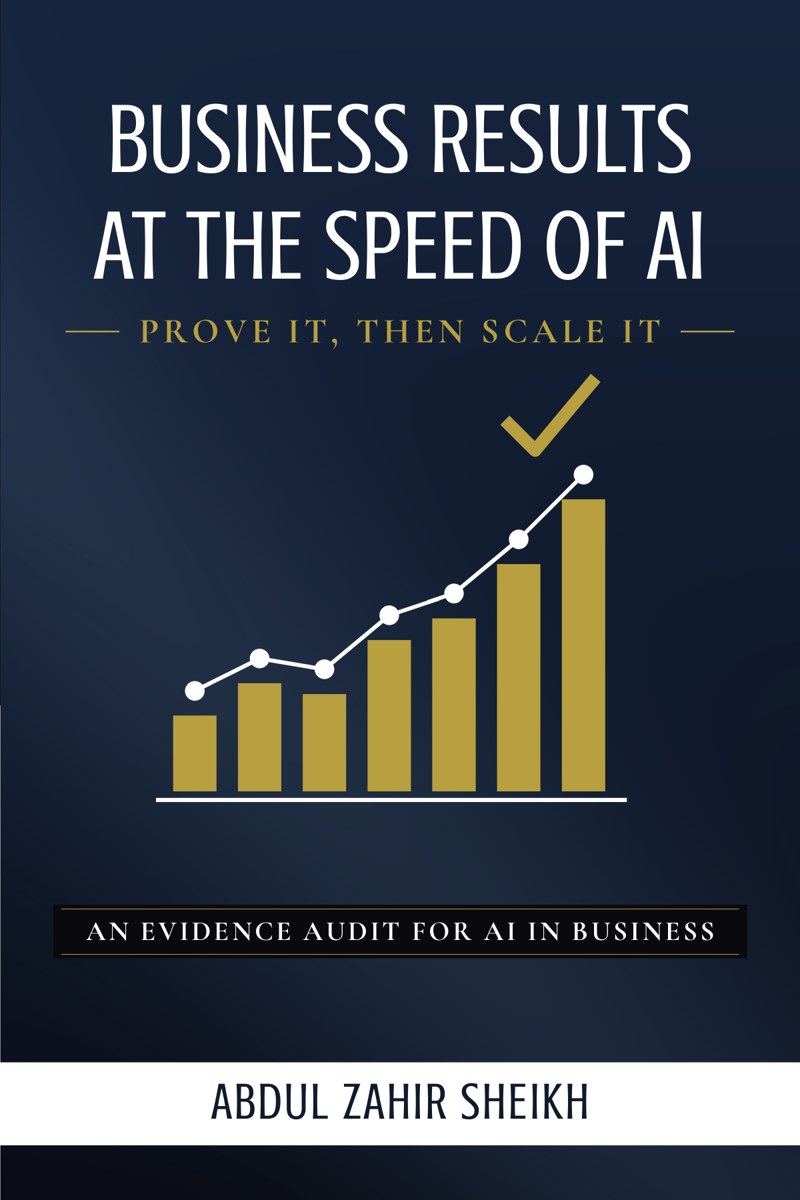 Business Results at the Speed of AI