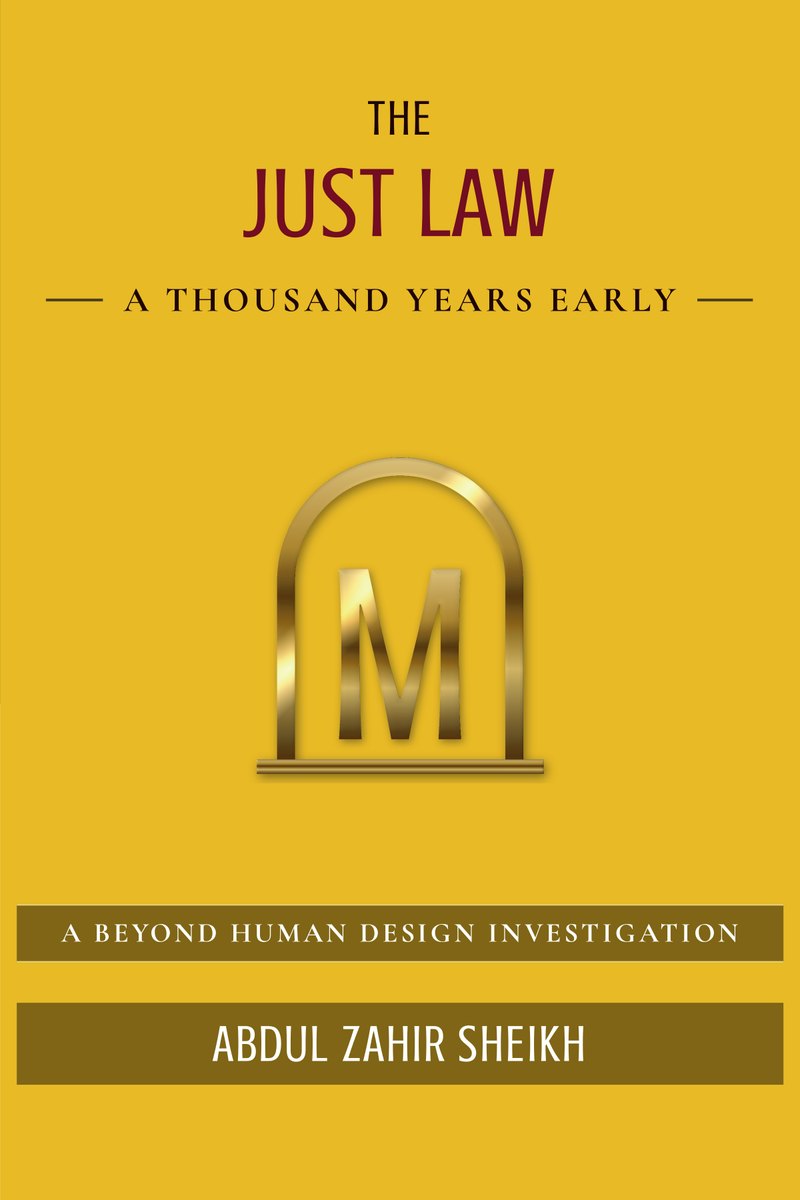
The Just Law
A Thousand Years Early
How the Quran Reached a Justice the World Would Not Reach for a Thousand Years
More than a dozen of the hardest charges against the Quran’s law, tried by the standard of justice the text publishes for itself, and dated against the codes of its age.
- Paperback
- 978-9914-776-36-2
- Hardcover
- 978-9914-776-38-6
- eBook
- 978-9914-776-37-9
The book in ten slides
About three minutes; each slide stays up long enough to read
About the book
The equality of every race. Daughters no longer buried alive. The captive fed. Fourteen centuries ago. Nobody has explained why.
The earlier volumes of Beyond Human Design established that the Author of the Quran is not human, and that the text describes the natural world as no seventh-century hand could. That verdict draws a portrait of an Author who is wise, knowing and, in His own repeated word, just. There is one place that portrait seems to fail. The same text lays down a law that, to a modern reader, looks like the mark of its century: a husband’s authority, a daughter’s half share, those “the right hand possesses”, the command to fight, and the bodily penalties. If the Author is just, how can His law read like this?
The book begins with the case against the law, not for it. More than a dozen charges, the hardest made against the text, are put first and at full strength, drawn mainly from scholars inside the tradition, with no reply offered there. Each is then tried by one measure: the standard of justice the text publishes for itself. The object of the trial is the text and the explanation the text appoints the Prophet ﷺ to give; what later jurists and states built on it is outside the trial.
A man can borrow the law of his age. He cannot borrow a law his age has not yet written.
The book then dates the law against the world. If it were simply the seventh century written down, its content should be findable in the codes within reach: Roman, Byzantine and Sasanian. It is not. No code within reach held a complete system of fixed shares owed as of right to the daughter, the wife, the mother and the sister. And on matters by which a moral code is finally judged, the text set down as binding command what the rest of the world would take more than a thousand years to reach: the equality of peoples, the worth of every life, humane treatment of the prisoner, no compulsion in religion.
Consider how an auditor handles a provision a reader will still refuse. He does not hide it, and he does not dress it up. Where the text permits a thing a modern reader will object to, the book says exactly that. The concubinage verses state no consent clause, and the book records it. The jizya is not modern equal citizenship. The objection to bodily penalty as such is named and placed outside the text’s measure.
Not one charge closes as a finding that the Author commanded an injustice by the standard He published.
Four ways to prove the book wrong are published before the evidence. The comparative legal history is drawn from the independent work of legal historians, from records a sceptic can check.
The book is written for the reader who has heard the charges and never the answers, for the believer who has met the hardest verses and wants to understand them, and for the scholar who will check every citation. Every verse is printed in Arabic with its reference.
Its finding is double. The charges did not stand, and the law did more than survive: it ran ahead of its age on the matters by which a moral code is finally judged. That is what the verdict of the earlier volumes would lead one to expect of an Author outside the age.
Written by Abdul Zahir Sheikh, a Certified Fraud Examiner and Senior Partner at BDO East Africa with four decades of investigative experience across fourteen countries, this is the book that tries the Quran’s law on its own terms and dates it against the world.
Read it as a system. Date it against the world. Explain how it got there first.
More books
 The Quran’s Hidden Architecture
 The Googol Verdict
 The Creator’s Signature on the World He Made
 Knowing the Creator
 The Authentication Test
 The Origination Map
 The Common Source
 The Network of Truth
 The Zakat Theorem
 The Crucifixion File
 The Absolute Benchmark
 The Just Creator
 One Creator, One Humanity
 The Sound Heart
 The Leadership Evidence Map
 Business Results at the Speed of AI