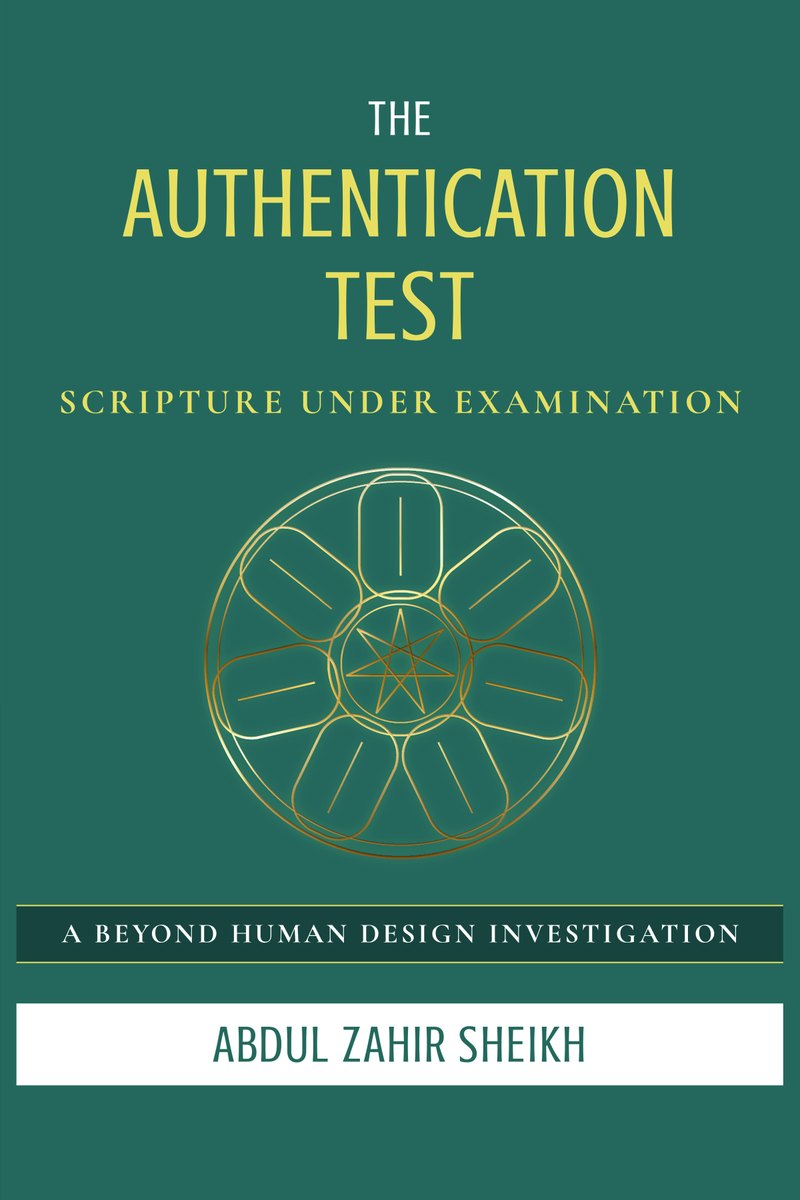
The Authentication Test
Scripture Under Examination
Seven Forensic Tests, and the One Text That Survives Them All
Seven forensic tests, built in the open before any text is examined. Six texts walk through the same instrument, scored identically. One row converges.
- Paperback
- 978-9914-776-20-1
- Hardcover
- 978-9914-776-19-5
- eBook
- 978-9914-776-18-8
The book in ten slides
About three minutes; each slide stays up long enough to read
About the book
Every scripture of revelation claims its words did not begin in a human mind. This book tests the claim the way contested authorship is tested anywhere else: by evidence.
For most of recorded history the claim has been adjudicated in the wrong room: in the temple and the seminary, by the light of devotion on one side and the heat of polemic on the other. A will challenged in probate, a manuscript of uncertain hand, a confession someone now disowns: we do not take a vote on which answer we would prefer. We open a file.
Seven tests are built first, in full view, before any text is examined: chain of custody, architecture, the stylometric fingerprint, the forger’s tells, the made world, borrowed pages, and the composite profile, which sets every alternative author against all the findings at once. Each has a pass mark fixed in advance and a stated condition under which it fails. The reader can test the instrument before having any reason to care about the result.
Six texts. One instrument. Identical scoring.
The Quran, the New Testament, the Torah, the Book of Mormon and the Book of Abraham then walk through the same seven tests, scored on the same criteria, with a modern channelled text as a control. The Book of Abraham calibrates the instrument: its source papyri survive, so its human origin is known, and the battery must find it. The results are assembled into one scorecard, read across the row rather than down the column, because a strong result on one test can be luck, while independent tests that agree are a signature.
Consider what a forensic examiner does with a disputed document. He does not begin with the conclusion he would like. He builds the tests, applies them to every candidate, and lets the row of results speak. Where a text passes tests that have nothing to do with one another, its transmission, its structure, its statistics and its content, the convergence is the evidence. Every chapter names the finding that would cause its test to fail.
A finding no evidence could overturn is not a finding but a creed. This one names what would overturn it.
What the book concedes is printed where it happened: the contested anachronism items, left on the table with their replies; the limits of stylometry in Arabic; the computer run on the Arabic rings, committed in Volume I and still to come. The other scriptures are treated as their own followers describe them, and each result is stated on its own ground, not on the ground of what the author believes.
Volumes I to IV of Beyond Human Design reached their verdict on the Quran’s Author beyond reasonable doubt. This book is the second examination a court trusts most: a fixed battery, applied blind and alike to every text that makes a like claim. One row converges, and the profile the evidence leaves matches the Author the text names for itself.
The scorecard is read row by row. The Book of Abraham fails decisively, as a calibration text should, and the control fails as a control should. The Book of Mormon gathers outright fails. The New Testament and the Torah return partials throughout, as multi-author traditions making a different kind of claim, a fairness choice the book explains rather than a slight.
Written by Abdul Zahir Sheikh, a Certified Fraud Examiner and Senior Partner at BDO East Africa with four decades of investigative experience across fourteen countries, this is the book that moves the oldest dispute about scripture out of the pulpit and into the examination room.
The scorecard is printed. The evidence is set before you. The decision is yours.
More books
 The Quran’s Hidden Architecture
 The Googol Verdict
 The Creator’s Signature on the World He Made
 Knowing the Creator
 The Origination Map
 The Common Source
 The Network of Truth
 The Zakat Theorem
 The Crucifixion File
 The Just Law
 The Absolute Benchmark
 The Just Creator
 One Creator, One Humanity
 The Sound Heart
 The Leadership Evidence Map
 Business Results at the Speed of AI