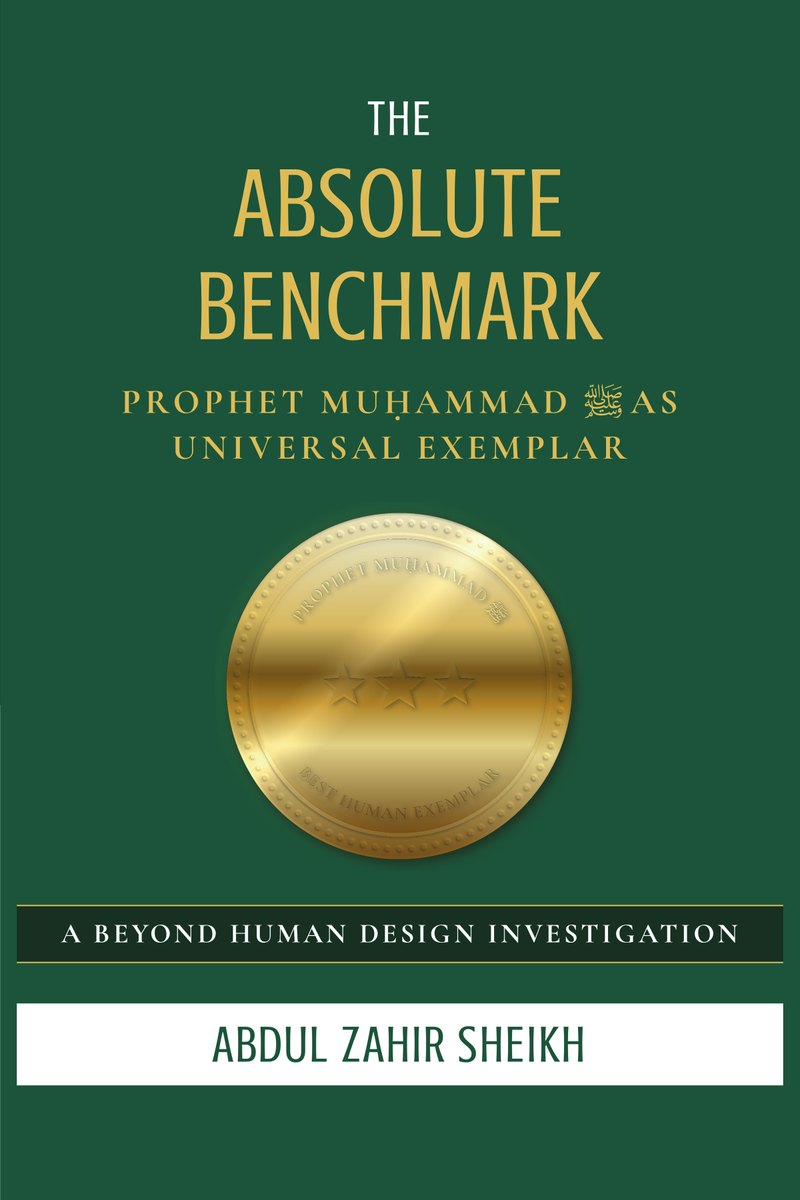
The Absolute Benchmark
Prophet Muhammad ﷺ as Universal Exemplar
The Standard the Quran Sets, and What the Evidence Shows
The Quran calls him an excellent pattern for all humanity. Sixteen metrics, fixed before the evidence is seen, test what the historical record would have to show.
- Paperback
- 978-9914-776-39-3
- Hardcover
- 978-9914-776-41-6
- eBook
- 978-9914-776-40-9
The book in ten slides
About three minutes; each slide stays up long enough to read
About the book
The Quran names him a pattern of conduct for all humanity. This book measures the claim with sixteen metrics fixed before a line of evidence is seen.
Three assertions are made about the Prophet Muhammad ﷺ: that he is an excellent pattern for anyone who hopes in God and the Last Day (33:21), a mercy to the worlds (21:107), and sent to all of humankind (34:28). Most books about him either assume the claim or attack it. This one asks what would have to be true in the historical record if the claim held, and then measures whether it is.
No figure had been examined like this. Not because examination was impossible, but because none had fixed its criteria before the subject was examined and published the conditions that would refute it. That is what this book does first: five conditions derived from the Quran’s own assertions, then sixteen metrics across six domains, transformation, pattern, harm, institutional survival, personal conduct and reach, each with a threshold set in advance, a comparison class from the historical record, and a falsification condition stated at the outset.
The question is not whether he was great. It is whether any other figure in the record clears all sixteen metrics at once.
Evidence is entered by tier, and the most sceptical model is computed first. External and material evidence is kept apart from the community’s own report, and a unanimous internal record that no outside source addresses is not allowed to count as corroboration. The comparison class includes Alexander, Caesar, Ashoka and every figure the record can support. Seven rival explanations for the result are stated at their strongest: six are discharged on named evidence, and the seventh, that the test was shaped by knowing the answer, is priced in full.
Consider how an examiner audits a reputation. He does not quote admirers; testimonials are placed in an appendix as reception, not evidence. He asks for the record and for the measure fixed before he looked at it. All sixteen metrics are scored, and every condition the claim entails is met at the reading the book stands behind and at every reading at which it can be computed.
A pre-registered case with published falsification conditions is not a defence of a position. It is an examination.
A standing challenge invites any reader to produce a candidate who meets all five conditions on documented evidence, and names what a valid response must contain. The final part turns from measurement to what the Quran itself says of him and what honouring him requires, because evidence about conduct does not by itself create an obligation; the obligation comes from the One who sent him.
The book is written for the believer who wants to know what the record can bear, for the sceptic who suspects the claim is unfalsifiable, and for the historian who wants the method laid out. Every metric is constructed so that it could return a negative result, and every source carries its tier.
The book also states the shape of its own evidence: its most public claims rest on its strongest evidence, and its most intimate claims on household testimony, the only evidence any private life leaves. For Alexander, Caesar or Ashoka, even that does not survive.
Written by Abdul Zahir Sheikh, a Certified Fraud Examiner and Senior Partner at BDO East Africa with four decades of investigative experience across fourteen countries, this is the book that holds the Quran’s claim about its messenger to a standard fixed in advance.
Pre-register the criteria. Name what would break the case. Then examine.
More books
 The Quran’s Hidden Architecture
 The Googol Verdict
 The Creator’s Signature on the World He Made
 Knowing the Creator
 The Authentication Test
 The Origination Map
 The Common Source
 The Network of Truth
 The Zakat Theorem
 The Crucifixion File
 The Just Law
 The Just Creator
 One Creator, One Humanity
 The Sound Heart
 The Leadership Evidence Map
 Business Results at the Speed of AI